Product supply
Maintain a defined product condition at the filler. Tank level, pressure, temperature, recirculation, entrained air and refill events can alter the dose or cycle.
A dependable bottle filler controls the dose and the container journey together, then hands a stable, clean pack to closure, labelling and inspection equipment.
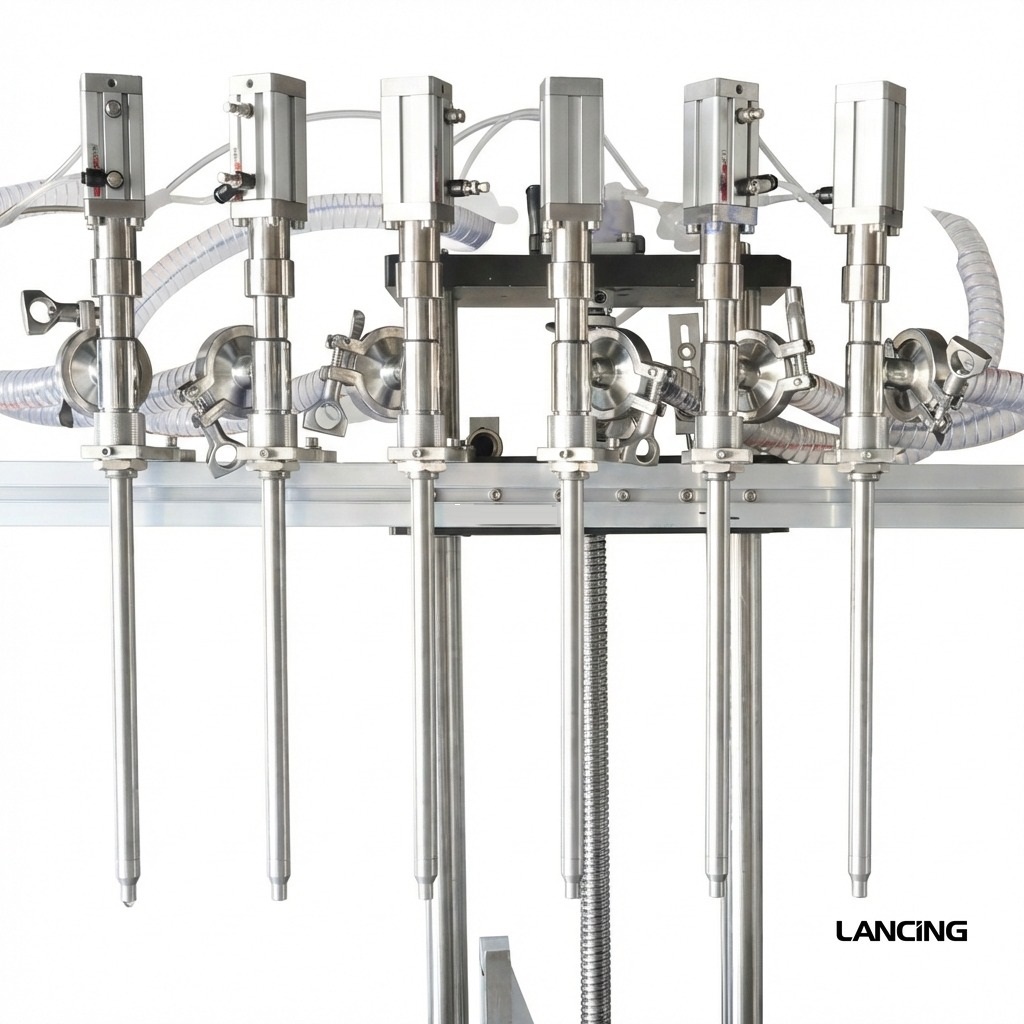
Dose accuracy alone is not enough if bottles arrive inconsistently, foam reaches the neck, drips contaminate the closure area or the outfeed cannot recover from a stop.
Maintain a defined product condition at the filler. Tank level, pressure, temperature, recirculation, entrained air and refill events can alter the dose or cycle.
Present the correct bottle in a stable orientation and consistent spacing. Confirm how fallen, missing or double-fed packs are detected and recovered.
Stop or track the bottle beneath the nozzle, verify position, apply the dose and prevent filling without a confirmed pack.
Control suck-back, shut-off, nozzle lift and dwell so the bottle shoulder, thread and conveyor remain clean enough for the next process.
Coordinate capping, induction sealing, labelling, coding, inspection and rejection with line permissions and accumulation.
Use the smallest dose, largest dose, least stable bottle and most difficult product as separate test cases. The most difficult combination may not be the largest pack.
| Selection variable | Why it matters | What to confirm |
|---|---|---|
| Liquid behaviour | Controls dosing principle, fill time, aeration, stringing and drip response. | Viscosity across operating temperature, foam, particles, solids settlement and product compatibility. |
| Bottle opening | Limits nozzle diameter and affects venting, splash and insertion depth. | Minimum internal neck dimension, eccentricity, finish tolerance and closure zone. |
| Bottle stability | Determines whether side guides, base control, neck handling or dedicated format parts are needed. | Empty and filled centre of gravity, base shape, flexibility and conveyor behaviour. |
| Dose range | A wide range may require different pumps, cylinders, tubing or settings. | Every marketed fill, legal fill basis where applicable and recipe-change procedure. |
| Fill presentation | The desired level, headspace and neck cleanliness affect nozzle motion and final cut-off. | Acceptable visual fill, foam settlement, wet-neck limit and time before capping. |
| Line rate | Head count must be supported by product feed, indexing and downstream stations. | Sustainable containers per minute under the agreed format and stop/restart conditions. |
| Cleaning | Product-contact design and access determine changeover time and cross-contamination control. | Flush, strip-down or other method; product recovery; waste handling; verification responsibility. |
Indexed filling creates a defined stationary window beneath the nozzles and can simplify bottle confirmation. Tracking systems move filling heads with the containers, which can reduce stop-start handling for suitable applications but add motion coordination and a defined tracking window. The choice must be tested against bottle stability, fill time, nozzle movement and downstream spacing.
Include the bottle thread, neck and closure in the acceptance criteria. A fill can be within dose tolerance yet still create capping or sealing problems if foam, stringing or drips wet the closure area.
Representative materials allow the project to test handling and pack quality rather than only demonstrate that a pump can move the liquid.
Send the liquid, bottle, fill range and required line sequence. Lancing can compare dosing, nozzle and container-handling routes, then identify the combinations that need a representative trial.
Provide the product and its operating condition, every fill volume, production bottles and closures, the required sustainable output, cleaning method and the stations before and after filling.
There is no single method for every bottled product. Pump or flow-controlled, piston, vacuum, peristaltic, gravity and other approaches suit different product behaviours, dose ranges and quality requirements.
Common concepts include gated indexing, timing screws, starwheels, neck handling or continuous tracking. The correct method depends on bottle stability, line rate, spacing and the required fill motion.
Yes, provided the mechanical handovers, control permissions, fault states, speed ownership, buffer strategy and reject logic are defined for the complete line.
The fill level, wet neck, foam, drips and bottle deformation can affect closure application and sealing. Testing the filled pack through the next operation reveals issues that a filler-only trial may miss.
The filler must control real empty and filled bottles, not only nominal dimensions. These questions define how variation and abnormal cycles are handled.
Bottle tolerance changes opening position, height, body width, stability and internal capacity. It can affect nozzle clearance, guide settings, fill level, indexing and transfer even when the nominal drawing is unchanged.
Supply production samples from normal batches and known extremes. Use the change-parts guide to control format-specific parts and settings.
An empty bottle may be light and easy to tip, while a filled bottle has different centre of gravity, inertia and surface loading. Guides that control the empty pack can scuff or restrict it after filling, and acceleration into capping can expose new instability.
Observe infeed, filling, discharge, accumulation and restart with both states represented.
The line should put the bottle into a defined, detectable state rather than allowing an empty pack to continue as normal. Depending on the design, it may stop, reject, mark or track the container. The response must remain clear after a sensor fault, product shortage or interrupted cycle.
Test no-container/no-fill and no-fill/container-present sequences during FAT with the downstream inspection and rejection logic active.
A part-filled bottle should not be automatically topped up unless the process has been designed and validated for that recovery. The machine must know which containers were affected by the stop and prevent an uncertain pack from entering normal output.
Define purge, reject, rework or controlled completion rules in the line control narrative and verify them after representative stops.
The controlled result depends on the declared quantity, bottle capacity variation and required shelf appearance. Fill-to-level methods can produce an even visual line in suitable rigid bottles, while volumetric methods control the metered dose and may show level variation.
Use the fill-level versus volume comparison to define the primary and secondary checks.
Send the product, pack and production evidence that applies to your line. Lancing can identify the next trial, specification or integration step without treating an assumption as a confirmed result.
Some products make the downstream release condition more important than the isolated dose. Foam can reach the neck, oil can transfer to a seal or label surface, and larger handled packs can move differently from conventional bottles.
State the finished-pack acceptance criteria in the trial: measured quantity, neck condition, cap or seal result, label area, traceability and reject handling.
| Pack or product condition | Main handling question | Detailed route |
|---|---|---|
| Small or narrow-neck bottle | Can the line locate the opening, vent displaced air and remain stable through capping? | Small-bottle filling machines |
| Bottle or jar filled warm or hot | Will the pack remain dimensionally stable and suitable for the intended closure? | Hot-fill machinery |
| Sauce or condiment | Can the nozzle deliver the texture cleanly without contaminating the neck or rim? | Sauce filling machines |
| Hygiene-sensitive product path | Can the product-contact system be cleaned, drained and verified by the site method? | Hygienic design and CIP |
Send the product, pack and output details that matter. We’ll compare the most practical dosing and line options for you.