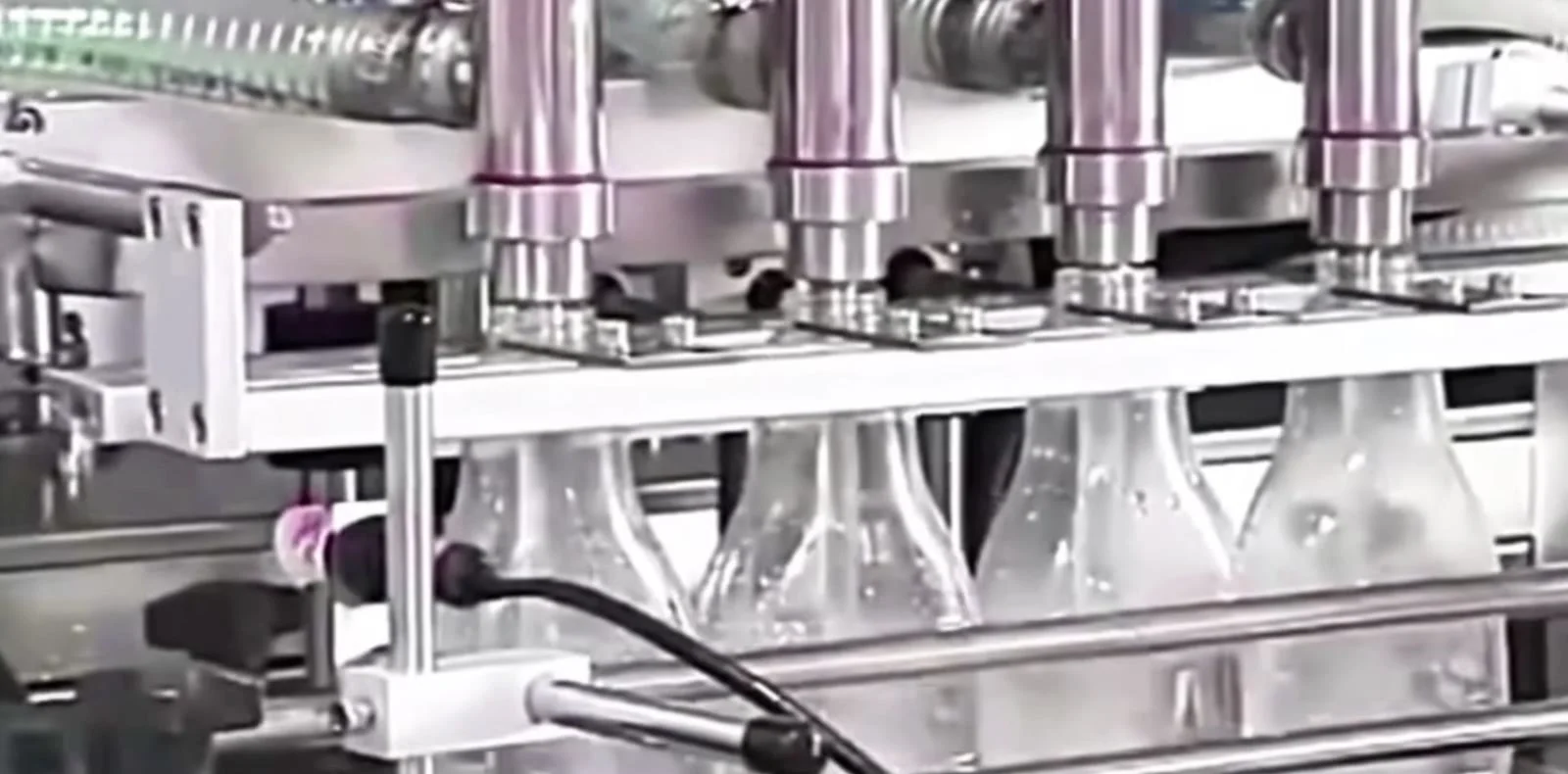
Why does a liquid foam during automatic filling?
A liquid foams when air is introduced or retained while it is pumped, accelerated, discharged or allowed to fall into the container. Product formulation matters, but feed-pump action, pipework, nozzle velocity, drop height, bottle geometry and temperature can all change the result. The filler must therefore be assessed with the complete product path, not from viscosity alone.
Foam may be created before the nozzle, so slowing only the final discharge does not always solve it. Observe the supply vessel, pump inlet, return path and manifold as well as the bottle.
Does every foaming liquid need bottom-up filling?
No. Bottom-up filling is useful when reducing the free fall of product materially reduces foam, but some products run acceptably with a controlled top fill, a carefully shaped nozzle or a fill-to-level method. A representative trial should compare nozzle position and fill profile because an unnecessary diving motion can add cycle time and changeover complexity.
Compare a stationary nozzle, a nozzle positioned within the neck and a true bottom-up profile only where each option is mechanically safe for the pack.
Is overflow or vacuum filling better than volumetric filling for foam?
Overflow or vacuum filling can be attractive when the visible fill level is the main requirement and the container geometry is consistent. Volumetric, flowmeter, piston or pump-based dosing may be preferred when the declared quantity is the controlling requirement. Foam stability, return-product handling, bottle-neck condition and the measurement system must be reviewed together.
Where product is recirculated or returned, confirm that the return does not aerate, contaminate or warm the bulk product.
Can product temperature change foaming performance?
Yes. Temperature can alter viscosity, dissolved gas behaviour, surface tension and pump load, so a setting proven with a cold sample may not behave the same at production temperature. The trial specification should record the normal temperature range and include the difficult start-up, steady-state and restart conditions.
Record temperature and conditioning time beside every result so the accepted recipe is tied to a reproducible product state.
How should output be assessed for a foaming product?
Output should be measured as sustained good containers through the complete line, not as an isolated filler cycle. The assessment must include foam-settling time, nozzle lift, bottle release, wet-neck control, cap application, label condition, rejects, replenishment and recovery after a stop.
A timed trial should report good containers at the line discharge and identify the actual constraint rather than quoting an unsupported nominal speed.
What samples are needed for a foaming-liquid trial?
Provide production-representative liquid, the smallest and largest containers, closures and any formulation or temperature variants likely to change foam. The quantity should be sufficient to prime the full product path, reach a stable condition, run repeated cycles and assess cleaning or product recovery afterwards.
Include enough closures to confirm that foam, splash or residue does not compromise capping, induction sealing or label adhesion.