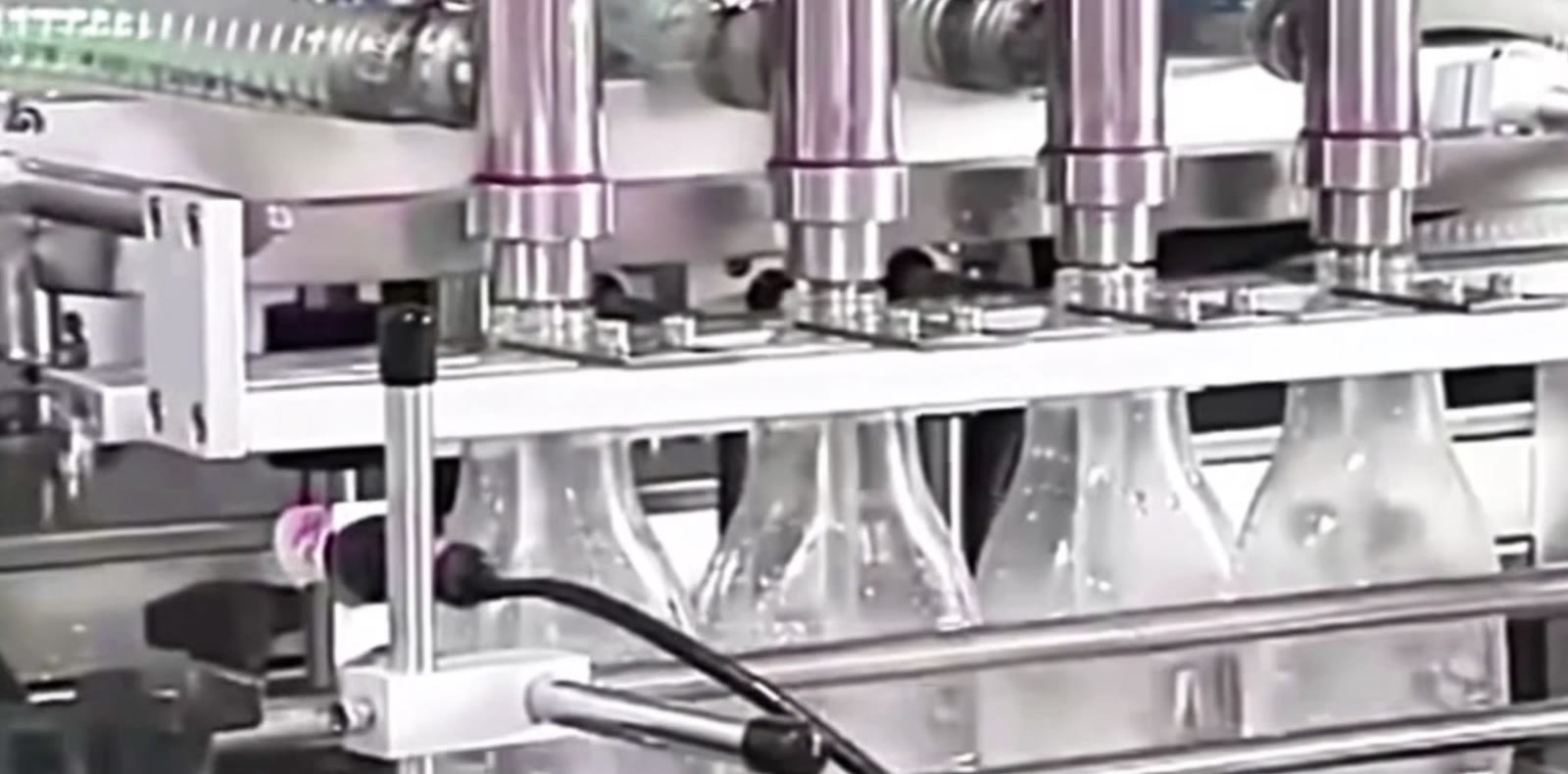
Does bottom-up filling always stop a liquid from foaming?
No. Bottom-up filling can reduce foam caused by free fall and surface impact, but foam can also come from the formulation, entrained air, pump shear, turbulent product feed, nozzle velocity or air displaced from the bottle. A diving nozzle is one part of the process, not a universal cure.
Trial the liquid at the actual temperature and feed condition. Observe foam height, settlement time, bottle-neck cleanliness and the delay before capping or sealing.
Should the nozzle remain below the liquid surface?
That depends on the product and nozzle design. Submerged filling can reduce air entrainment for some liquids, but it can also create pressure, backflow, contamination or product carry-over if the nozzle is not vented and controlled correctly. Other products perform better with the tip just above the rising surface.
Define the intended gap or submersion and verify it across container tolerances, fill levels and nozzle positions. The final profile should be a recorded recipe or mechanical setting.
How much clearance is needed around a diving nozzle?
Enough clearance is needed for the nozzle, any vent path and the normal positional and dimensional variation of the container. There is no universal value. The opening, neck geometry, guide system, container centring, nozzle run-out and machine movement all contribute to the risk of contact.
Provide drawings and production samples rather than a nominal neck diameter alone. Trials should include containers from normal manufacturing tolerance and confirm no contact during start, stop and restart.
How does nozzle movement affect filling-machine output?
Insertion, synchronised withdrawal and return add motion to each cycle. The effect depends on travel distance, acceleration limits, fill time, number of heads and whether motion overlaps other steps. Bottom-up filling can still support high output, but the complete motion sequence must be included in the cycle calculation.
Measure sustained performance with the required profile active. Do not compare a static-nozzle demonstration with a production duty that needs diving motion.
Why does bottom-up filling affect capping and sealing?
The final nozzle position, shut-off and withdrawal determine whether product reaches the neck, thread or sealing land. Foam or a trailing string can contaminate the closure interface even when the measured dose is correct. That can affect cap application, induction sealing, vacuum checks or visual inspection.
Include closures in the trial and inspect the filled container after the realistic transfer and settlement time, not only while it remains beneath the nozzle.
When is a stationary top-fill nozzle the better choice?
A stationary nozzle can be preferable when the product fills cleanly without excessive foam or splash, the container opening is difficult to enter, changeovers are frequent, or added nozzle motion would not improve the result. Simpler motion can also reduce cycle time and changeover variables. The choice should follow a product and pack trial.
Use the least complex method that consistently meets dose, cleanliness, pack handling and downstream requirements under normal and interrupted production states.