Unit 5A Jefferson Way, Thame, Oxfordshire, OX9 3SZ

Search machine types, applications, buyer guidance and filling-line topics.

Container-led filling selection

How do you choose an automatic filler for small or narrow-neck bottles?

Small packs make nozzle diameter, bottle centring, dose control and closure handover especially important. The filler must match the liquid, minimum dose and cleaning route while the conveyor and indexing system keep lightweight bottles stable beneath the nozzles.

  • Control low-volume dosing and priming
  • Locate narrow openings without contact
  • Integrate cap placement and inspection
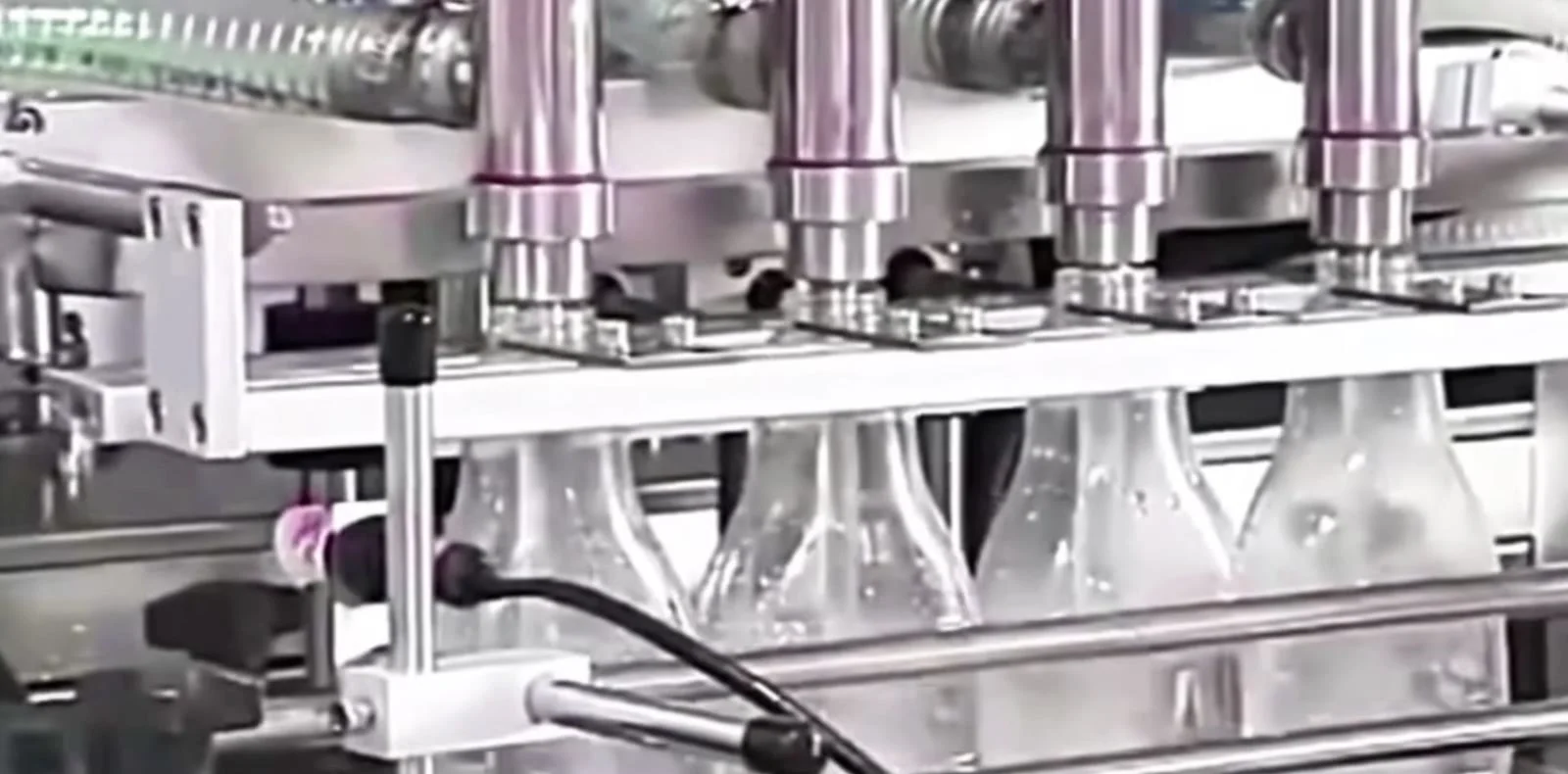
Automatic multi-head filling machine presenting bottles beneath filling nozzles
Small-bottle filling should be proven with production bottles, closures and the real minimum dose
Direct answer

Start with the bottle opening and minimum dose

An automatic small-bottle filler should be selected by combining the product-contact method with the usable nozzle clearance, minimum fill quantity, bottle stability and downstream closure task. Peristaltic, pump, piston, flow-controlled, vacuum or other routes may be suitable, but each has different priming, cleaning and container-handling requirements.

Small bottles can be harder to automate than larger packs because the empty container is light, the neck opening gives little tolerance, and a small drip or air pocket can represent a significant proportion of the fill. The line must therefore be assessed from bottle infeed through filling, cap placement, capping, labelling and reject handling.

Pack constraints

The container controls nozzle access and line stability

Pack featurePotential effectWhat to test
Narrow or variable openingLimits nozzle bore and venting and reduces centring tolerance.Smallest opening, neck-position variation and nozzle clearance under normal conveyor conditions.
Lightweight empty bottleCan tip, bounce or deform under guide, gate or nozzle forces.Infeed gaps, indexing, fill start, release, accumulation and restart.
Tall or high-centre-of-gravity packBecomes less stable as guides change and the liquid level rises.Least stable format at the intended conveyor speed and transfer points.
Offset or non-central openingMay require orientation, nests or format-specific nozzle positioning.Orientation method, repeatability and changeover evidence.
Small closure or dispensing componentCap placement may be more difficult than the fill itself.Closure feed, presence detection, torque or seating and reject recovery.
Tight label panelFill residue or bottle movement can affect coding and label placement.Finished-pack condition through the complete downstream sequence.
Dosing routes

Compare measurement method, product path and changeover

RouteUseful selection questionEvidence required
Peristaltic or tubing-based fillingDoes a replaceable tube path suit the liquid, dose and campaign pattern?Tube compatibility, priming, calibration, air control, minimum dose and tube-change procedure.
Micro-piston or positive displacementCan the piston, valves and nozzle manage the product across the full dose range?Valve filling, seal compatibility, air exclusion, clean cut-off and cleaning access.
Pump or flow-controlled fillingCan the pump or meter deliver stable small doses at the real feed condition?Supply pressure, product temperature, calibration, nozzle response and head-to-head balance.
Vacuum or fill-to-levelIs consistent visible level more important than a measured volume in a rigid pack?Bottle rigidity, neck seal, recovered-product handling and quantity-control boundary.

Use peristaltic filling guidance for the tube-path decision and fill level versus fill volume to define the controlling measurement principle.

Line integration

Build a stable container journey around the filling window

  1. 1

    Feed and separate bottles

    Use an infeed method that presents the empty pack in a repeatable orientation and gap without damage.

  2. 2

    Locate the opening

    Guides, gates, nests or format parts position the bottle while sensors verify the expected pack state.

  3. 3

    Fill with controlled venting

    The nozzle, product velocity and air escape path are matched to the neck and liquid.

  4. 4

    Transfer to closure handling

    Keep the neck clean and the bottle stable for cap, plug, dropper, spray or pump placement where required.

  5. 5

    Inspect and recover faults

    Define missing-bottle, no-fill, missing-closure and reject behaviour without creating a line-wide spill.

Dose evidence

Use a measurement method suited to the quantity and product

Agree whether acceptance is based on mass, volume, visible level or another documented measure. The method, equipment resolution, sample handling and settling time should be defined before comparing machines. A result stated without those conditions can make two different systems appear comparable when they are not.

For small doses, evaluate priming, first-off containers, air in the product path, nozzle residue and the effect of tube, valve or seal condition. Averages can hide individual missed or short fills, so retain the raw container results and head identity during trials.

Small-pack trial set

  • Minimum, maximum and common fills
  • Smallest opening and least stable bottle
  • Normal caps, plugs, droppers, pumps or sprays
  • Production liquid at the real temperature
  • Normal bottle dimensional variation
  • Defined measuring and reject method
Buyer questions

Common questions about small-bottle filling

Which filling method is suitable for small liquid doses?

Small liquid doses may be filled by peristaltic, piston, pump, flow-controlled, time-pressure or level-based methods depending on the product, required quantity, neck opening and cleaning route. The method should be chosen from the complete dose range and product behaviour rather than from one nominal fill.

Representative trials should include the smallest dose because priming, tube condition, valve response, air and nozzle residue can become a larger proportion of the result.

Why can a narrow bottle neck limit filling speed?

A narrow bottle neck limits the usable nozzle diameter and the space available for displaced air to escape. Increasing product flow without enough venting can create splash, back pressure, foam or wet threads, while small centring errors can cause nozzle contact or product outside the pack.

Bottle drawings and production samples are needed to confirm the usable clearance and fill profile.

Can one automatic filler run several small bottle sizes?

One filler may run several small bottle sizes when the dose range, bottle height, neck position, stability and closure formats stay within the machine design. Recipes, guide adjustments, nozzles, starwheels, timing screws or other change parts may be needed depending on the handling method.

The complete format list should be supplied before the machine is specified so the difficult changeover is not discovered later.

When should peristaltic filling be compared with piston filling?

Peristaltic filling is worth comparing when a replaceable tube path, small doses or straightforward product-contact changeover are important. Piston filling may be considered when positive displacement, different viscosity or a broader dose route is required. Product compatibility, minimum dose, priming, cleaning and sustained output decide the better option.

Neither method should be selected from accuracy language alone; the test conditions and measuring method must be the same.

How are missed bottles and spills prevented on a small-bottle line?

Small-bottle spills are reduced by controlling bottle separation, guide pressure, sensor position, indexing, nozzle alignment and no-container/no-fill logic. The line should be tested with the lightest and least stable empty bottle, including gaps, short stops, accumulation and restart.

A successful fill station is not enough if the bottle then tips during transfer to the capper.

What samples are needed to specify a narrow-neck bottle filler?

Supply production product, the smallest and largest bottles, normal closures, bottle and neck drawings where available, the full fill range, target output, cleaning method and downstream operations. Include the least stable bottle and any format with an unusually small or offset opening.

Samples should be from normal production tooling because dimensional variation can change nozzle clearance and cap handling.
Before quotation

Information Lancing needs for a small-bottle project

  • Product behaviour and full fill range
  • Bottle and neck drawings or samples
  • Closure component and application method
  • Target sustained output and batch pattern
  • Cleaning and product-change route
  • Upstream infeed and downstream labelling or inspection

Send the difficult small-pack format first

Lancing can compare the dosing principle, nozzle, bottle handling and closure route and identify where a product-and-pack trial is needed.

Choose with confidence

Get a filling-machine shortlist built around your product.

Send the product, pack and output details that matter. We’ll compare the most practical dosing and line options for you.

Call an expert