Nozzle cut-off
Choose the nozzle and final-flow profile around drip, string and pressure-release behaviour. The nozzle should clear the pack safely without transferring residue to the neck or sidewall.
Oil and lubricant filling depends on viscosity across the production temperature range, the quantity-control method, pack scale and how cleanly the nozzle closes. The best route may differ between small bottles, handled jerrycans and palletised drums.
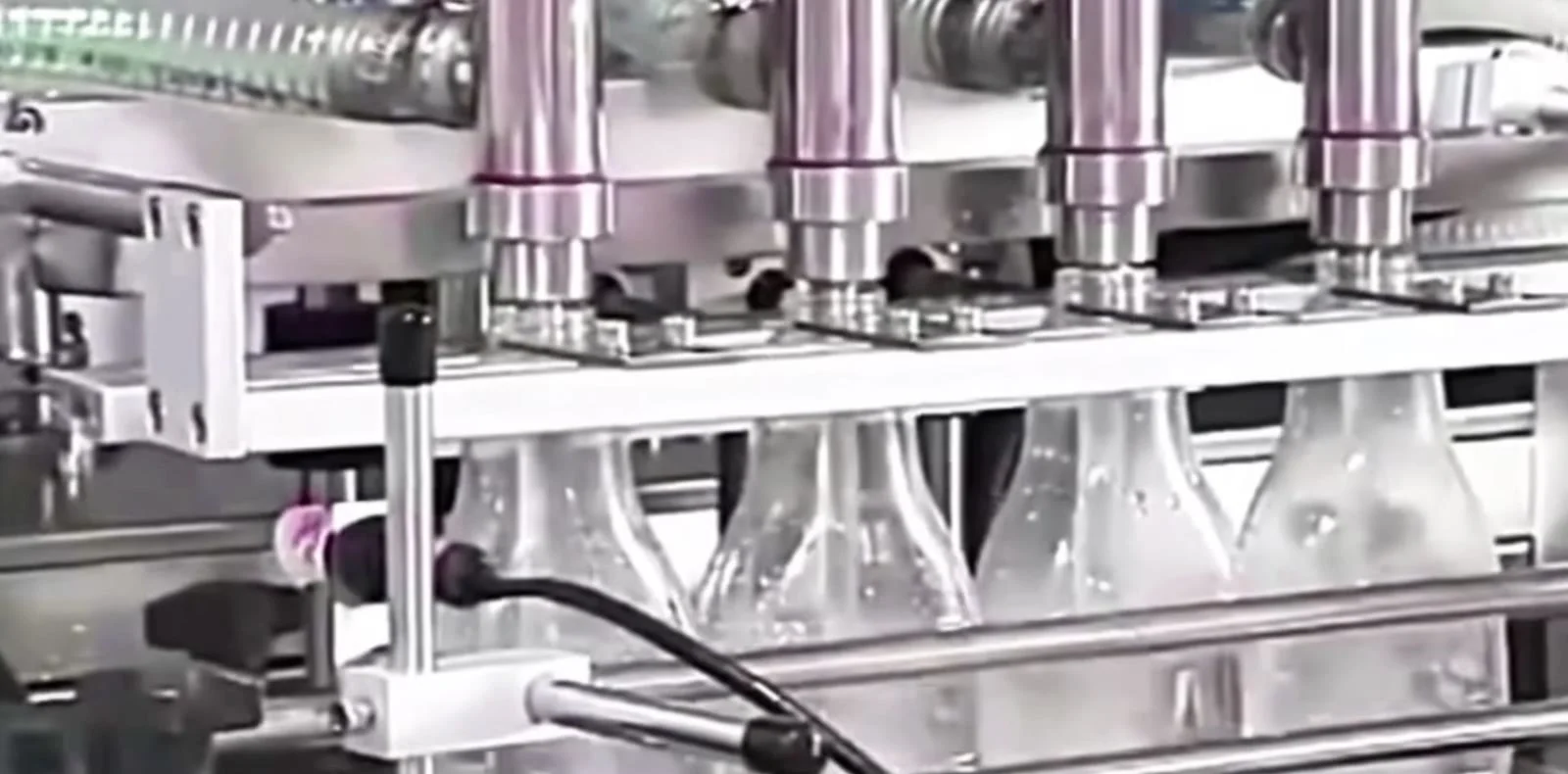
Automatic oil and lubricant filling can use piston, pump, flowmeter, servo-controlled or gravimetric principles. Selection starts with the product at its coldest and warmest credible conditions, then considers the fill quantity, container opening, nozzle shut-off, product feed and downstream closure. A representative trial should prove both the measured dose and a clean finished pack.
| Route | Where it can be useful | Questions to resolve in a trial |
|---|---|---|
| Flowmeter or controlled pump | Free-flowing to moderately viscous oils with a stable, full product path | Meter suitability, air exclusion, temperature effect, cut-off and calibration method. |
| Piston or other positive displacement | Products needing a defined displaced volume and controlled suction/discharge | Valve path, cylinder range, seals, suck-back, cleaning and viscosity at cold start. |
| Servo-controlled dosing | Projects needing stored motion or dose recipes across several verified formats | Recipe limits, feedback, head balance, changeover controls and recovery after faults. |
| Weigh filling | Applications where mass is the direct acceptance measure or large packs make weight feedback practical | Platform capacity, container tare, coarse/fine feed, vibration, settling and legal-use requirements. |
Choose the nozzle and final-flow profile around drip, string and pressure-release behaviour. The nozzle should clear the pack safely without transferring residue to the neck or sidewall.
Light bottles can deform or move, while handled jerrycans may vary in panel shape and handle position. Guides, stops and nozzle alignment must be proven with production samples.
Confirm that the closure seats correctly, an induction-seal surface remains suitable and the label area is clean. Reject logic should distinguish a dose problem from a handling or cap fault.
Run from the lowest credible temperature through the normal steady condition. Record dose, fill time, nozzle cut-off and pump load rather than accepting one warm sample.
Check full, normal and low-level feed conditions. Confirm that refill, recirculation or agitation does not introduce air or create a different inlet pressure.
Hold the line for a realistic break, then inspect the first packs after restart for delayed flow, drips, settling and recipe recovery.
Define how residual product is recovered, how shared paths are drained and what evidence confirms the next grade is not contaminated.
There is no single best method. Free-flowing oils may suit a flowmeter or controlled pump route, while more viscous products may justify positive-displacement or piston dosing. Weigh filling can be useful where the sale or acceptance criterion is mass, especially for larger packs. The final choice depends on temperature, viscosity range, pack size, accuracy method and cleaning.
Shortlist at least two credible routes where the product and pack range is broad, then compare them with the actual oil and production conditions.
Oil viscosity can change with temperature, affecting pump load, flow profile, cut-off and the time required to deliver a dose. A recipe accepted with warm product may not remain suitable after a cold start. Specify the normal and extreme product temperatures and test both where they can occur in production.
Where temperature is controlled upstream, define who owns that control and how the filler is prevented from running outside the accepted range.
Drip control may combine a positive nozzle shut-off, suck-back or pressure relief, an appropriate hose path, controlled final flow and a short settle period. The correct arrangement depends on product viscosity and the nozzle position. It must be checked over repeated cycles because a clean first fill does not prove stable operation.
Include the closure and label process: a small residue on the neck or sidewall can create a larger downstream failure.
A dosing technology may cover more than one pack range, but the complete machine may not. Bottle indexing, jerrycan support, nozzle reach, conveyor loading, pallet handling, guarding and operator access change substantially with pack scale. Wide ranges should be divided into practical format groups and each group trialled.
For mixed pack ranges, document which change parts, nozzle positions and handling settings belong to each format family.
The answer depends on the declared quantity, the product and the business checking system. Volumetric and flow measurement can be efficient for stable liquids, while gravimetric filling measures mass directly. Density and temperature must be understood when converting between mass and volume. The packer remains responsible for the quantity-control system.
Where packaged-goods law applies, confirm the checking equipment and records with the business’s competent metrology or Trading Standards adviser.
Check dose repeatability at the normal temperature range, clean nozzle shut-off, bottle or jerrycan stability, wet-neck condition, cap and seal performance, label adhesion, product replenishment, pause/restart behaviour and cleaning or product recovery. Record results against a defined checking method rather than visual judgement alone.
Use enough product to reach a stable feed condition and enough packs to expose warming, pressure change and recurring drip behaviour.
Lancing can review the oil condition, pack family and line scope, then identify which dosing routes should be compared in a product trial.
Send the product, pack and output details that matter. We’ll compare the most practical dosing and line options for you.