Bottles and narrow openings
Nozzle diameter, venting, bottle centring and string control become critical. The filled neck must remain suitable for cap placement, induction sealing or another closure operation.
Sauce filling is governed by texture, temperature, particles, air, container opening and clean cut-off. A suitable automatic line must dose the product without damaging it, keep the rim or neck ready for closing and support practical cleaning between recipes.
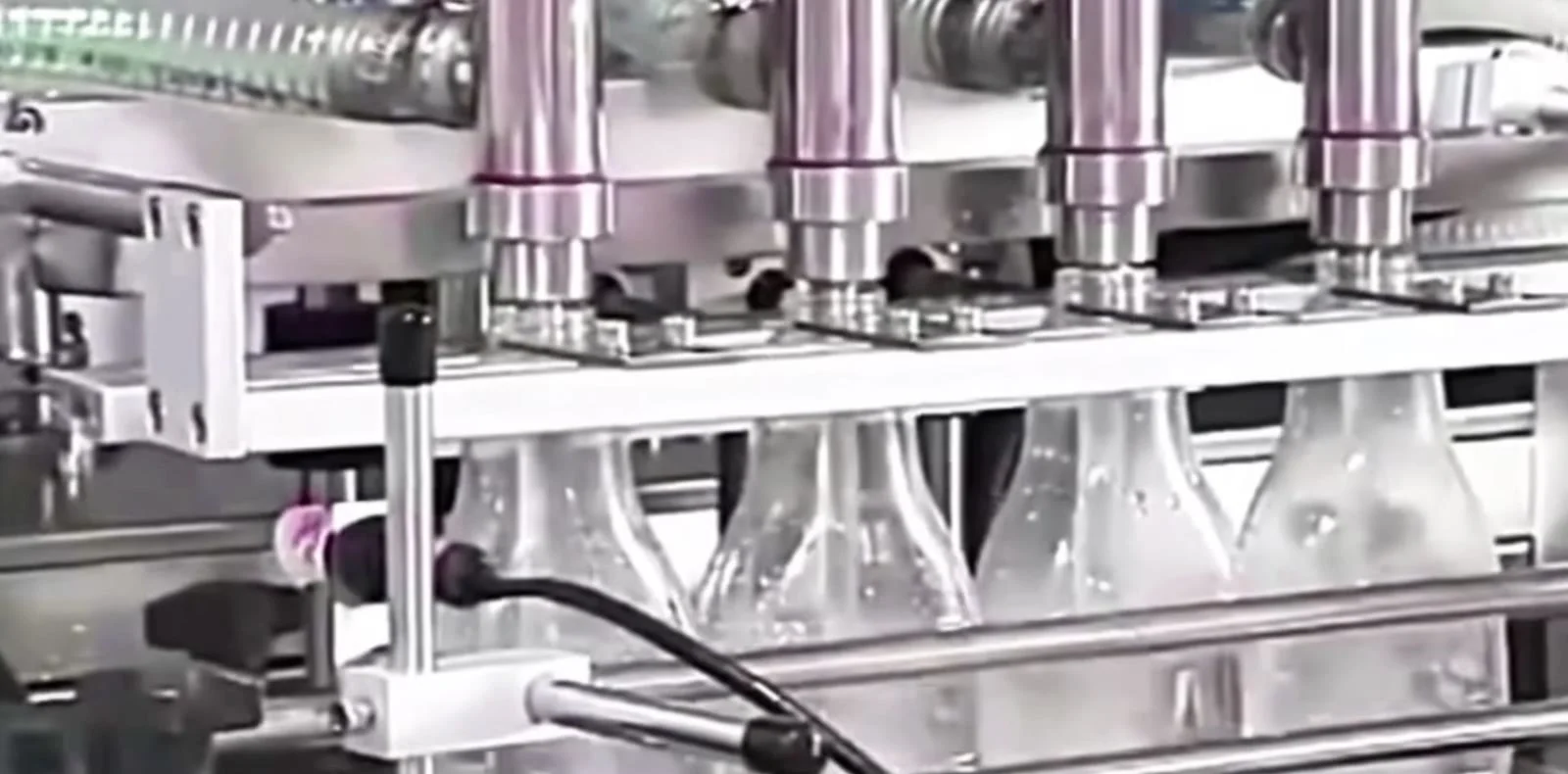
An automatic sauce filler should be selected from the complete product behaviour: viscosity at filling temperature, particles, shear sensitivity, entrained air, settling, stringing and the way product leaves the nozzle. The bottle, jar or tub opening and the closure process then determine how the container is presented and how clean the rim must remain.
A broad label such as “sauce” can describe a smooth dressing, a dense mayonnaise, a sticky syrup or a cooked product with vegetable pieces. Those products may require different valves, pumps, nozzle bores, product-feed arrangements and cleaning methods. Build the specification around the most difficult product and pack that the machine is expected to run routinely.
| Product condition | Machinery questions | Trial evidence |
|---|---|---|
| Smooth free-flowing sauce or dressing | Can a compatible pump or measured-flow route deliver the dose without aeration or splash? | Fill profile, cut-off, head-to-head result and neck cleanliness at production temperature. |
| Viscous ketchup, mayonnaise or puree | Will a piston, servo positive-displacement or suitable pump maintain feed and clean separation? | Hopper refill, valve filling, nozzle tail, pause/restart and product recovery. |
| Sticky syrup, honey or glaze | Does product temperature change flow and stringing, and can the nozzle close cleanly? | Cold start, steady run, heated condition where applicable and end-of-batch behaviour. |
| Sauce with herbs, seeds or pieces | Can the complete path pass the largest normal particle without blockage or unacceptable damage? | Particle distribution, piece integrity, valve/nozzle clearance and cleaning access. |
| Foaming or aerated sauce | Where is air introduced and can the feed, dosing profile or nozzle movement reduce it? | Production mixing and transfer route, settling time, fill condition and closure result. |
Nozzle diameter, venting, bottle centring and string control become critical. The filled neck must remain suitable for cap placement, induction sealing or another closure operation.
Wide openings allow larger product paths but require control of rim contamination, fill height and the transfer into twist-off, screw or press-on closure equipment.
Pack support, indexing and sealing-zone cleanliness may dominate the layout. Filling and lidding or sealing should be trialled as one sequence.
A repeatable dosing module cannot compensate for a hopper that bridges, a transfer pump that aerates the sauce or a manifold that separates particles between heads. Record how product arrives from the process vessel and how the filler remains supplied during normal replenishment.
For products containing pieces, every restriction matters. Compare the largest normal particle with the hopper outlet, pump clearances, valve ports, hose or pipe bore, manifold and nozzle. For smooth sauces, focus on air entry, pressure variation, shear and clean cut-off.
Maintain the agreed temperature, mixing and product level without introducing unnecessary air or damaging particles.
Guide and locate the least stable bottle, jar or tub beneath the nozzle set.
Deliver the required quantity while controlling splash, strings, drips and product on the rim or neck.
Apply the closure or seal, verify the pack condition and manage rejects without contaminating the line.
Recover usable sauce, isolate the equipment, clean the product path and verify the next recipe setup.
Use the automatic bottle-line guide for container infeed, capping, labelling, coding and inspection interfaces.
| Trial state | What to observe | Why it matters |
|---|---|---|
| Cold or first production start | Priming, product feed, air, initial temperature and first acceptable packs. | Start-up waste and stabilisation can dominate short batches. |
| Normal sustained run | Dose result, particle distribution, nozzle cut-off, pack stability and closure cleanliness. | Confirms useful production rather than an isolated successful cycle. |
| Hopper or vessel replenishment | Feed pressure, level, aeration, mixing and head-to-head balance. | Refill can change product conditions presented to the dosing system. |
| Controlled pause and restart | Drips, skinning, settling, temperature change and first-off result. | Normal line stops often reveal tailing and restart faults. |
| End of batch and cleaning | Residual product, recovery, drainage, strip-down and safe access. | Determines giveaway, changeover time and operator task. |
Ketchup, mayonnaise and dressings are usually compared by viscosity, shear sensitivity, air content, temperature, particles and cut-off behaviour rather than by product name. Piston, servo positive-displacement or compatible pump routes may all be practical, but the choice should be confirmed with representative product and the real bottle or jar.
The feed system and nozzle are part of the same decision because an otherwise repeatable dose can still leave strings, trapped air or a contaminated rim.
An automatic sauce filler can be considered for products with pieces only when the hopper outlet, pump or valve, manifold and nozzle provide sufficient clearance and acceptable product handling. The trial should use the largest normal pieces and assess blockage, damage and container-to-container distribution.
A smooth base sauce is not a valid substitute for a production batch containing the normal particle load.
One machine may run bottles and jars when the fill range, pack dimensions, opening positions and handling window fit the design. Different guides, nozzles, indexing parts, recipes or change parts may be needed, and the least stable pack should be tested through filling and closure.
Container changeover should be assessed alongside the cap or lid format, not as a filler-only task.
Drips and stringing are controlled by matching the product path, discharge profile and nozzle shut-off to the sauce and pack opening. A shut-off nozzle, suck-back, controlled deceleration, nozzle movement or temperature control may help, but the correct method depends on how the product separates at the end of the dose.
The accepted result should include a clean closure zone after a sustained run and after pause and restart.
A sauce filler can cover more than one temperature condition only when the product-contact components, seals, hoses, control method, container and cleaning route are suitable for the full agreed range. The effect of temperature on viscosity, particles, pack stability and dose repeatability must be trialled.
Do not assume that a machine proven with an ambient sauce is automatically suitable for the same recipe filled hot.
A useful sauce-filling trial needs production-representative product, the smallest and largest packs, normal closures, the full fill range, production temperature, target output and the required cleaning method. Products with particles should include the normal maximum piece size and concentration.
Provide enough product to test start-up, a sustained run, replenishment, pause and restart rather than only a few individual doses.
Lancing can compare piston, servo, pump-fed and complete-line routes and identify the trial needed to confirm product passage, cut-off and container handling.
Send the product, pack and output details that matter. We’ll compare the most practical dosing and line options for you.