Large-port piston route
A piston can deliver a defined displaced volume, but the inlet valve, outlet valve, cylinder and nozzle must pass the inclusions without cutting or trapping them. Suction behaviour and hopper feed are part of the test.
Products containing pieces, fibres, seeds, herbs or suspended solids must pass through the complete feed, valve and nozzle path without blocking, separating or unacceptable damage. The selection depends on the worst credible inclusion and how consistently it is distributed.
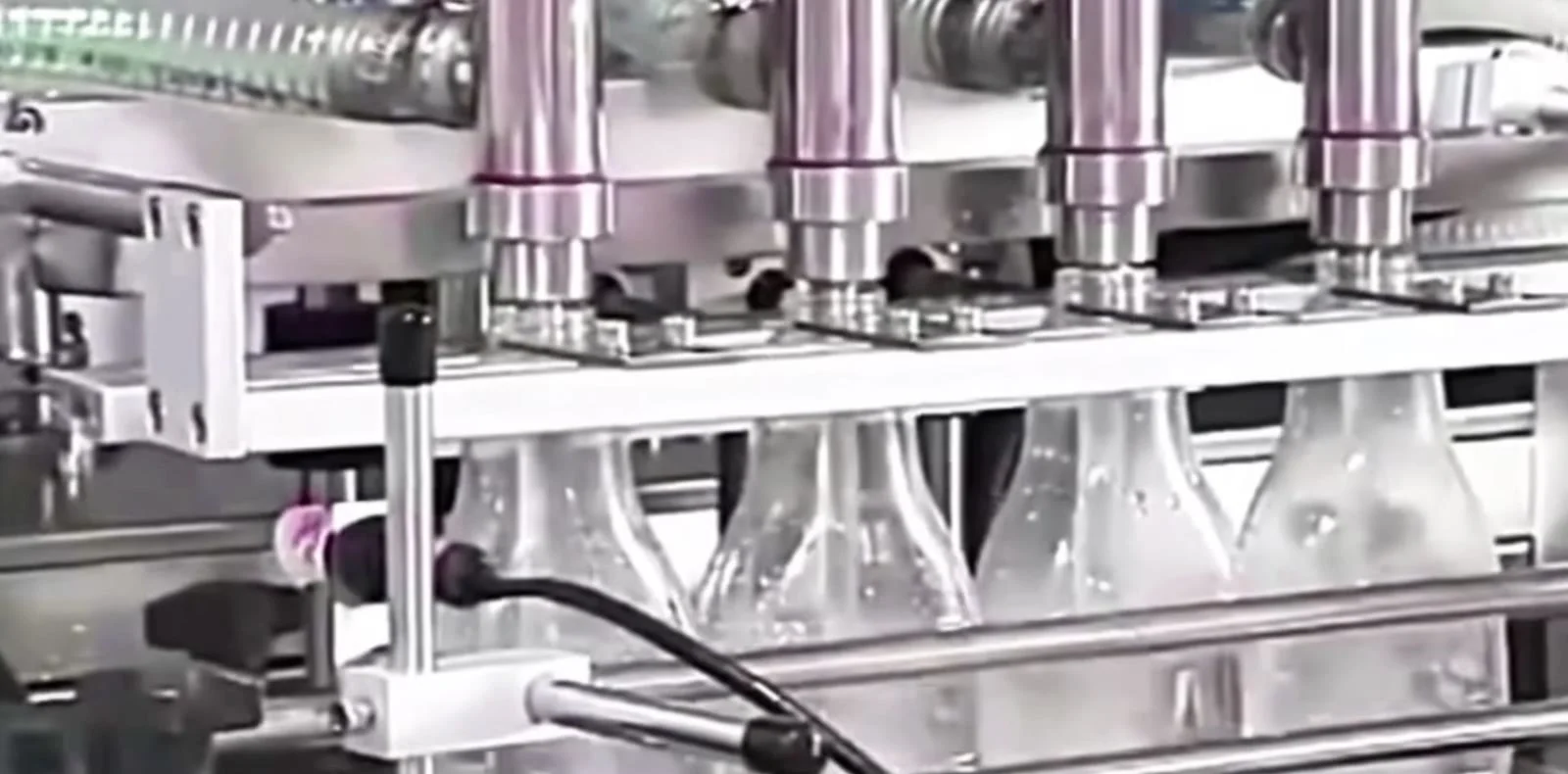
A filling machine for products with particles must move both the carrier and the inclusions through the hopper, pump or piston, valves, hoses and nozzle. The controlling specification is normally the largest credible particle or cluster, not the average texture. A representative trial should prove dose quantity, particle distribution, product condition, shut-off and cleaning over the complete batch state.
| Property | How to describe it | Machine effect |
|---|---|---|
| Maximum particle size | Length, width, thickness and occasional clusters | Sets minimum passages and affects valve/nozzle selection. |
| Particle shape | Round, fibrous, leaf, flake, irregular or string-like | Changes bridging, orientation and cutting risk. |
| Fragility | Acceptable breakage, crushing or surface damage | Limits shear, clearances and valve movement. |
| Concentration | Typical and worst solids content across the batch | Affects distribution, feed consistency and dose variation. |
| Density and settling | Whether pieces float, suspend or settle and how quickly | Determines hopper geometry, agitation and refill control. |
| Carrier behaviour | Viscosity, temperature, stringing, foam and lubrication | Influences suction, discharge, cut-off and cleaning. |
A piston can deliver a defined displaced volume, but the inlet valve, outlet valve, cylinder and nozzle must pass the inclusions without cutting or trapping them. Suction behaviour and hopper feed are part of the test.
A pump may support continuous feed or gentler transfer for some products. Pump type, speed, shear, priming, pressure, reversible recovery and cleanability must be assessed with the real formulation.
If the pieces cannot be distributed reliably in one product path, a separate solids and liquid dosing process or another packaging method may be more appropriate. That decision should be made from pack-quality evidence, not only cycle time.
A product with particles often needs a positive-displacement or pump route with valves, hoses and nozzles sized for the largest credible inclusion. A piston may be suitable for some sauces or pastes, while other products may need a gentler pump or different feed arrangement. The route must be proven with the actual particle size, concentration, fragility and carrier viscosity.
Do not rely on a catalogue viscosity band; the product pathway and valve action must physically pass the difficult inclusion.
One oversized piece can bridge a valve, block a nozzle or prevent complete closure even when the average product appears easy to fill. Specify the largest credible length, width and shape, including occasional clusters, and test the worst production batch rather than a sieved demonstration sample.
Provide an unscreened production sample and describe how particle size varies between batches, storage time and temperature.
The feed vessel may need gentle agitation, controlled recirculation or a short product path, but excessive movement can damage inclusions or introduce air. The objective is representative distribution at every dose. Compare the first, middle and final fills from the batch and inspect particle count or mass using an agreed method.
If agitation is used, define speed, direction, running time and low-level behaviour as part of the accepted recipe.
Yes. Tight clearances, rapid valve movement, sharp changes in direction, high pump shear and narrow nozzles can cut or crush inclusions. Damage may also occur in the upstream transfer pump. Inspect the filled product, not only the dose weight, and compare it with the approved product condition.
Review the complete path from bulk vessel to nozzle because the filler cannot restore particles already damaged upstream.
Separate the total quantity result from the distribution of inclusions. A pack can meet its total weight or volume while containing too few or too many pieces. Define whether acceptance concerns total quantity, piece distribution, solids-to-liquid ratio, visual appearance or all of these, then use a sampling method appropriate to the product.
Where a legal quantity declaration applies, retain a separate compliant measurement and record system for the packaged goods.
Pieces can remain in valve cavities, hose low points, manifolds and nozzle shut-off mechanisms. The design should provide access or validated flushing for every product-contact area. The changeover method must account for trapped inclusions, allergen or flavour carryover where relevant and safe removal of heavy or awkward tooling.
Cleaning evidence should cover disassembly, inspection, reassembly and the first acceptable pack after changeover.
Lancing can review the actual inclusions, carrier, pack and quality criteria, then identify the filling routes and trial evidence needed.
Send the product, pack and output details that matter. We’ll compare the most practical dosing and line options for you.