Pneumatic piston control
A proven format for defined strokes where compressed air and valve timing are appropriate for the application.
Use a defined swept volume to fill oils, sauces, creams, gels and other products that need positive displacement and clean nozzle control.
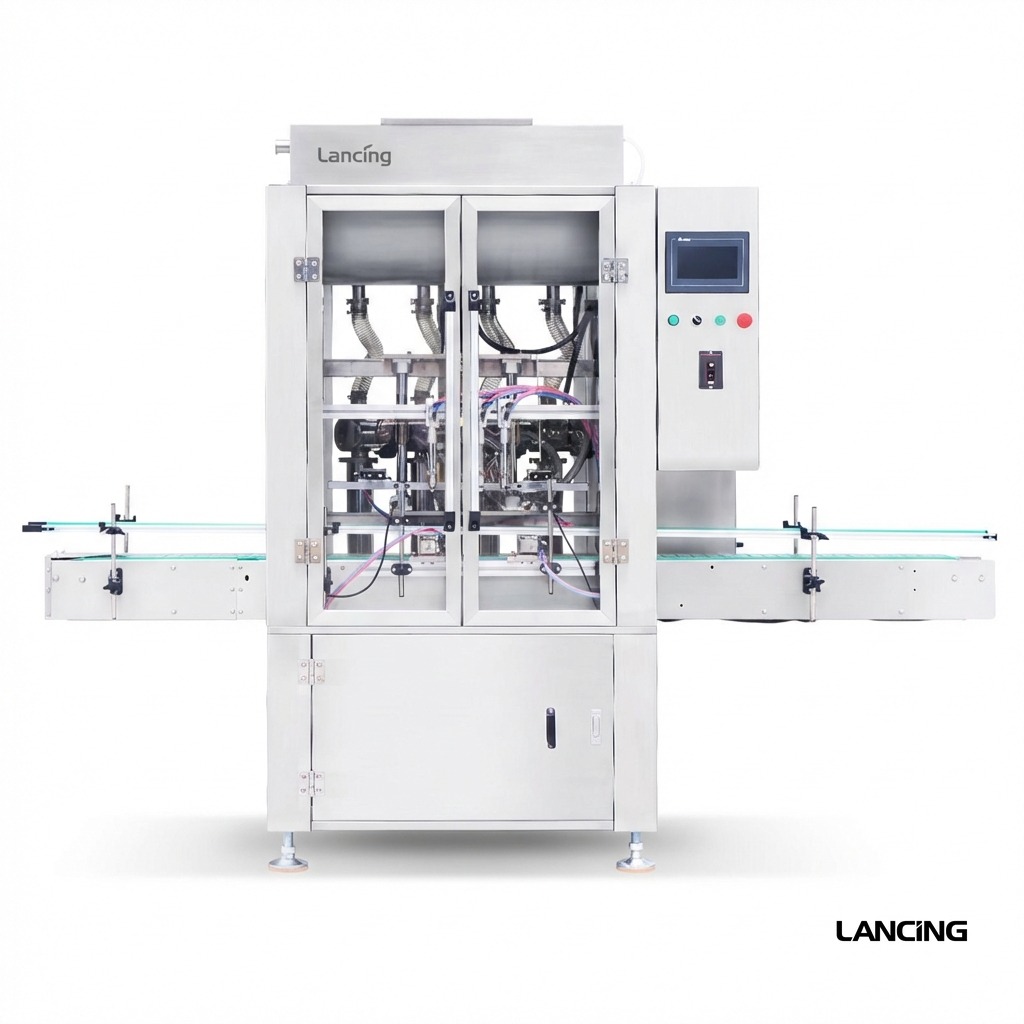
A piston filler draws product into a measuring cylinder and then discharges it through the nozzle. The principle is straightforward, but production performance depends on cylinder sizing, valve geometry, seal materials, product feed and the way the piston motion is controlled.
Automatic piston machines can be configured with several filling heads to match conveyor output. For wider fill ranges, the project may require alternative cylinders or a design that keeps the working stroke in an accurate and stable part of its range.
The final route should be confirmed against representative product and containers.
A proven format for defined strokes where compressed air and valve timing are appropriate for the application.
Provides programmable motion profiles, recipe storage and controlled speed through different parts of the fill cycle.
Several matched cylinders and nozzles increase output while the indexing system keeps containers aligned.
Optional product conditioning can support products that change viscosity or settle in the hopper.
The details differ by machine, but these stages define the core control problem.
The piston retracts and draws product through the inlet valve.
Stroke length and cylinder geometry establish the nominal dose.
The piston advances while the outlet valve sends product to the nozzle.
The nozzle closes, containers index onward and the next intake cycle begins.
A complete enquiry reduces avoidable assumptions and makes machine comparisons more meaningful.
| Cylinder size | Matched to the minimum and maximum dose rather than only the largest fill |
|---|---|
| Valve type | Selected for viscosity, particles, hygiene and cleaning access |
| Seal material | Compatible with product chemistry, temperature and cleaning agents |
| Nozzle | Bore, shut-off, diving movement and suck-back where needed |
| Feed | Gravity hopper, pumped supply, heated vessel or level-controlled tank |
| Controls | Recipes, stroke calibration, alarms and line communication |
Use these configurations to compare machine routes. Final fill range, speed and accuracy are confirmed against your product, container and line.
A compact conveyorised format with four dosing heads for liquid and paste applications.
Servo-driven piston motion for projects that benefit from programmable fill profiles and automatic recipe control.
A filler performs best when infeed, closure, labelling and accumulation are sized around the same design rate.
Compare alternative filling methods and the equipment that may be needed before or after the filler.
Answers are general guidance. Final suitability depends on product trials, containers and the confirmed machine specification.
They can provide repeatable volumetric dosing when the cylinder is correctly sized and the product feed, seals, valve timing and temperature are stable. Accuracy must be agreed for the actual product and speed.
Potentially, but suitability depends on viscosity, valve and nozzle design, cylinder range and cleaning. A trial or detailed product review is recommended when the products behave very differently.
Servo control can store recipes and shape the fill motion, for example using a gentle start or slower final phase to reduce splash, foam or product stringing.
The answer comes from dose time, container indexing, sustained line output and downstream capacity. More heads do not help if capping or container handling becomes the bottleneck.
Compare the next most relevant machine routes before you choose a final specification.
Automatic servo filling machines with programmable recipes, controlled fill profiles and multi-head options for liquids, creams, sauces and pastes.
View optionsAutomatic paste filling machines for sauces, creams, gels, honey, adhesives and viscous products, with piston, servo and pump-fed options from Lancing Ltd.
View optionsPositive displacement is repeatable only when the complete product path fills consistently and cuts off cleanly in the real container.
A piston filler measures a dose by drawing product into a cylinder and discharging it through valves and a nozzle. The cylinder is only one part of that measurement chain. Valve filling, trapped air, seal condition, feed pressure and nozzle cut-off can all change the delivered result. The specification should therefore identify the product-contact module, valve path and feed condition that will be used at the smallest, largest and most common production doses.
The product must pass through every restriction without unacceptable damage or delay. Thick products, fibres and particles can require larger passages or different valve arrangements, while free-flowing liquids may create drip or splash concerns at the nozzle. Where the product changes with temperature, the trial should include the expected operating window rather than a single convenient condition.
Head count should be justified by the complete cycle. Adding pistons can reduce filling time only when the hopper or supply manifold keeps each cylinder full, the conveyor presents containers accurately and downstream equipment accepts the increased flow. Head-to-head balance should be assessed after start-up, a normal pause and a product refill because those events can reveal air or feed differences not visible in a short demonstration.
For the wider range of piston, pump and cup dosing principles, including semi-automatic options, use Volumetric Fillers UK. This page remains focused on automatic piston systems and their integration into conveyorised production.
| Component | Selection question | Output/accuracy condition | Cleaning and maintenance | Interface to confirm |
|---|---|---|---|---|
| Cylinder or dosing module | Does the selected displacement cover the real dose range without relying on an unsuitable extreme? | Test the smallest, largest and common fills at the normal product condition | Define access, seal inspection, lubrication controls and reassembly checks | Manual, pneumatic or servo drive; recipe or adjustment method |
| Inlet and outlet valves | Can the passages fill and discharge without trapping air, blocking or damaging particles? | Stable valve filling is required for repeatable displacement | Demonstrate safe opening, cleaning and correct reassembly | Product feed pressure, hopper level and no-product logic |
| Nozzle and shut-off | Can the nozzle enter the pack and stop the product cleanly? | Assess dose with splash, drip, stringing and rim cleanliness | Include seals, tips and drip-control parts in cleaning and spares review | Nozzle lift, diving profile, bottle-present sensing and reject handling |
| Manifold and multi-head balance | Can each cylinder receive the same product condition? | Record head-to-head results under sustained feed and after interruptions | Show product recovery and access to common passages | Feed pump or hopper capacity, level control and head isolation |
| Change parts and settings | Are adjustments clear for each container and dose? | Repeat a documented change and verify the first accepted containers | Confirm identification, storage and cleaning of removed parts | Recipe permissions, mechanical scales and line-clearance checks |
Compare piston-filler proposals using the same product, feed condition, dose set and acceptance method.
The piston stroke must be considered with valves, feed stability, nozzles and individual-head results.
Air in the cylinder, incomplete valve filling, changing product temperature, unstable feed pressure, seal condition or product trapped at the nozzle can alter the delivered amount. Testing must control and record those conditions.
Use representative product and containers, record each head separately, agree the sampling method and test after start-up, normal pauses and product refill. The acceptance record should include dose, rejected packs and any adjustments made.
Send the product, pack and output details that matter. We’ll compare the most practical dosing and line options for you.