Hygiene and access
Product-contact parts, drains, crevices and change parts need a cleaning route appropriate to the food and risk profile.
Match product texture, temperature, particles, hygiene and allergen controls to the filling route and the container-closing sequence.
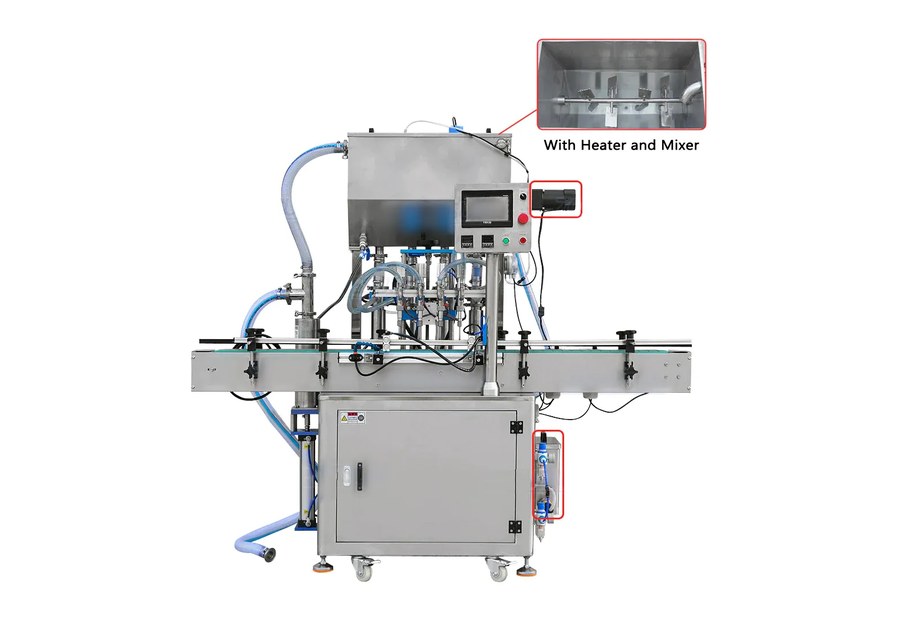
A product name is only the start. Production temperature, texture, chemistry and cleaning requirements decide the machine route.
These factors commonly change the dosing method, nozzle, product feed or line layout.
Product-contact parts, drains, crevices and change parts need a cleaning route appropriate to the food and risk profile.
Pieces, seeds and inclusions affect valve bore, hose diameter, nozzle design and dose repeatability.
Product temperature changes viscosity and can affect container stability, seals and downstream closure.
Product recovery, flush quantity, strip-down and production scheduling should be agreed before the machine is selected.
The best shortlist normally contains two or three practical routes tested against the real product and pack.
Sauces, honey, jams and viscous food products where positive displacement and a clean shut-off are required.
Oils, syrups and selected beverages where the product and hygiene requirements match the chosen pump or meter.
Powders, spices, coffee, granules and ingredients that need dry-product dosing.
Filling combined with cap or lid placement, closing, labelling, coding and inspection.
Send enough detail to assess dosing, product-contact design, container handling and downstream operations.
Compare alternative filling methods and the equipment that may be needed before or after the filler.
Answers are general guidance. Final suitability depends on product trials, containers and the confirmed machine specification.
Some piston and pump systems can, provided the particles fit through the product path without damage or blockage. Send representative product and define the largest inclusion.
Positive-displacement piston or pump routes are often considered. Temperature, stringing, nozzle cut-off and the dose range determine the final design.
Potentially, with temperature-compatible product-contact parts, heated tanks or hoses and containers designed for the fill temperature. The full process needs review.
Cleaning can range from strip-down and manual wash to defined flush or CIP arrangements. The method depends on the product, hygiene standard and machine design.
Compare the next most relevant machine routes before you choose a final specification.
Automatic paste filling machines for sauces, creams, gels, honey, adhesives and viscous products, with piston, servo and pump-fed options from Lancing Ltd.
View optionsSpecify automatic liquid filling machines for free-flowing, foaming, oily and medium-viscosity products, with UK advice on dosing, nozzles and line integration.
View optionsPlan automatic filling machine cleaning, product recovery, allergen control, strip-down, flush routines, recipes and container changeover.
View optionsA sauce, dressing or prepared product may change across temperature, mixing and batch level. Pieces can settle, float, cluster or be damaged by a tight valve or high-shear transfer route. The filler trial should therefore measure total quantity and the agreed condition or distribution of inclusions.
| Food-product question | Why it matters | Evidence to bring |
|---|---|---|
| What is the largest credible inclusion? | Controls valve, hose and nozzle passage. | Unscreened production sample and dimensions of occasional clusters. |
| Does the product separate? | Changes hopper, agitation and refill design. | First/middle/final batch samples and normal hold time. |
| Can pieces be damaged? | Limits pump shear and valve movement. | Approved visual or physical condition after filling. |
| What must be cleaned between products? | Determines access, dismantling and verification. | Allergen/flavour sequence and the site cleaning method. |
Use the guide to filling products with particles and provide the actual product, container, closure and cleaning requirements.
Food suitability depends on the actual product, site procedure and risk assessment. The filling machine should support the required process; it does not establish shelf life, allergen control or microbiological safety by itself.
Send the product, pack and output details that matter. We’ll compare the most practical dosing and line options for you.