Overflow vacuum filling
Liquid is drawn to the set level and excess product returns through the system.
Use vacuum level filling when the finished shelf appearance and consistent liquid height are more important than an identical volumetric dose in every bottle.
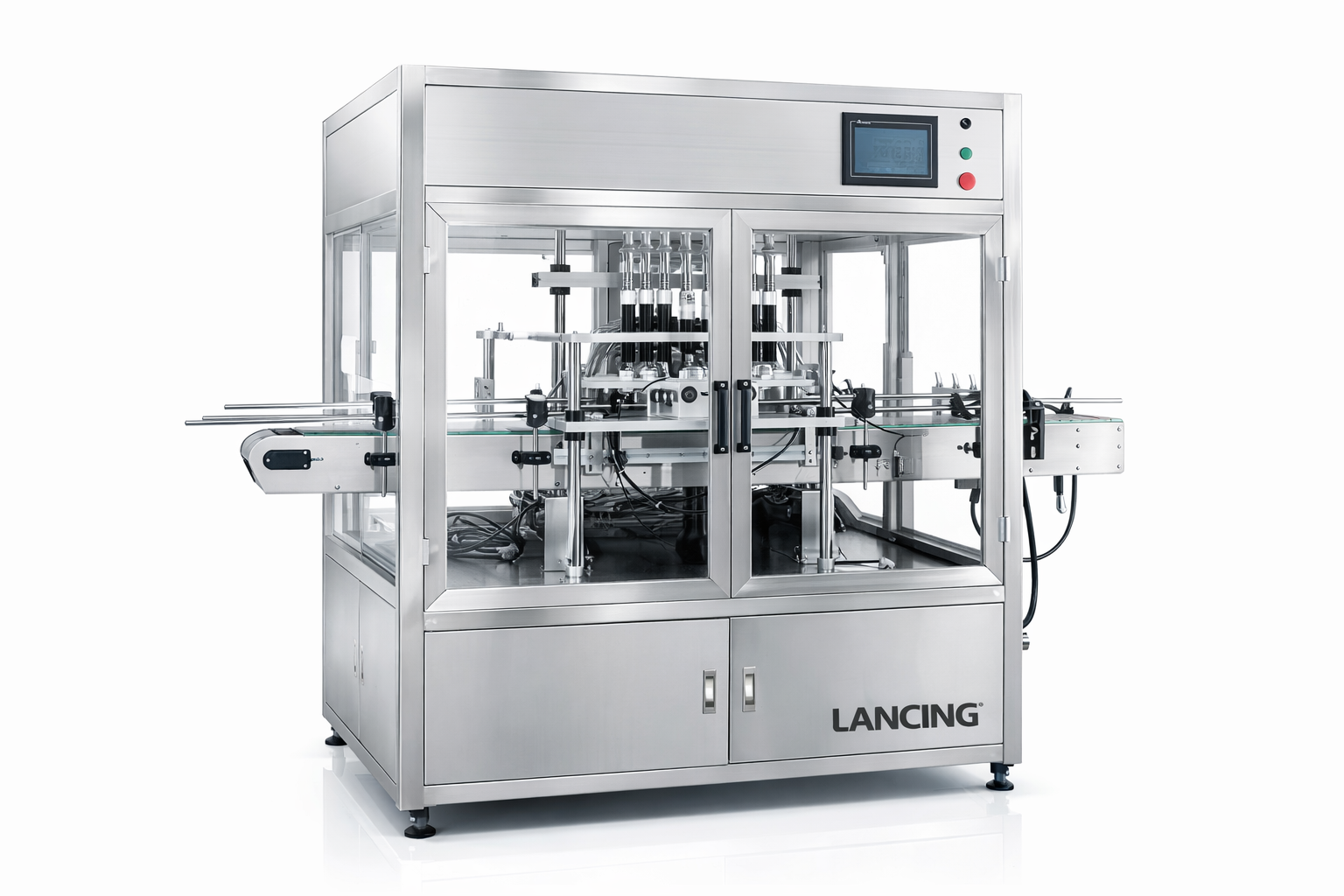
Vacuum filling draws liquid into a rigid container until a return path reaches the set level. Small variations in the internal volume of glass or rigid plastic bottles can therefore be absorbed while the visible liquid height remains consistent.
The method is most relevant to low-viscosity products and containers that can withstand the operating vacuum. Product recovery, foaming, aroma, hygiene and compatibility with seals and hoses must be reviewed before the route is selected.
The final route should be confirmed against representative product and containers.
Liquid is drawn to the set level and excess product returns through the system.
Several nozzles operate together within a guarded automatic machine.
Vacuum filling can be arranged with cap placement, crimping, labelling and coding.
Return paths and reservoirs must minimise contamination and preserve the product.
The details differ by machine, but these stages define the core control problem.
The bottle neck and nozzle establish the required filling circuit.
Pressure difference draws product into the container.
The return path controls the visible liquid height.
The bottle moves to closure application and finishing operations.
A complete enquiry reduces avoidable assumptions and makes machine comparisons more meaningful.
| Container rigidity | Resistance to deformation under the selected vacuum |
|---|---|
| Neck finish | Seal geometry, opening size and dimensional consistency |
| Product | Low viscosity, foam, volatility, aroma and hygiene needs |
| Fill level | Target height and allowable visual tolerance |
| Recovery | Return tank, filtration and contamination controls |
| Closure | Screw cap, plug, pump, spray or crimp sequence |
Use these configurations to compare machine routes. Final fill range, speed and accuracy are confirmed against your product, container and line.
An enclosed automatic level-filling example for delicate or low-viscosity liquids.
A filler performs best when infeed, closure, labelling and accumulation are sized around the same design rate.
Compare alternative filling methods and the equipment that may be needed before or after the filler.
Answers are general guidance. Final suitability depends on product trials, containers and the confirmed machine specification.
It is primarily a level-filling method. If bottle internal volumes vary, the actual quantity may vary while the visible fill height remains consistent.
Only if the container is sufficiently rigid and the neck seals correctly. Thin-wall bottles may deform, so samples should be assessed.
It is generally used for thin, free-flowing liquids. More viscous products usually require a piston, pump or another positive-displacement route.
Yes. A compact line can include filling, plug placement and crimping, but product volatility, ventilation and closure details must be considered.
Compare the next most relevant machine routes before you choose a final specification.
Specify automatic liquid filling machines for free-flowing, foaming, oily and medium-viscosity products, with UK advice on dosing, nozzles and line integration.
View optionsAutomatic bottle filling lines integrating filling, capping, labelling, coding, inspection and conveyors for UK liquid, paste and chemical production.
View optionsBoth routes can create a controlled visible level in suitable rigid bottles, but they use different product and recovery paths. Review overflow filling machines where pressure or pump-assisted supply and a return path may suit the liquid and required output. Use the fill-level versus fill-volume guide to keep presentation and net quantity as separate requirements.
Send the product, pack and output details that matter. We’ll compare the most practical dosing and line options for you.