Anti-corrosion gravity or pump filling
Uses chemically compatible tanks, pumps and product-path materials for free-flowing aggressive liquids.
Build chemical compatibility, vapour control, cleanability and operator protection into the filling line from the first specification review.
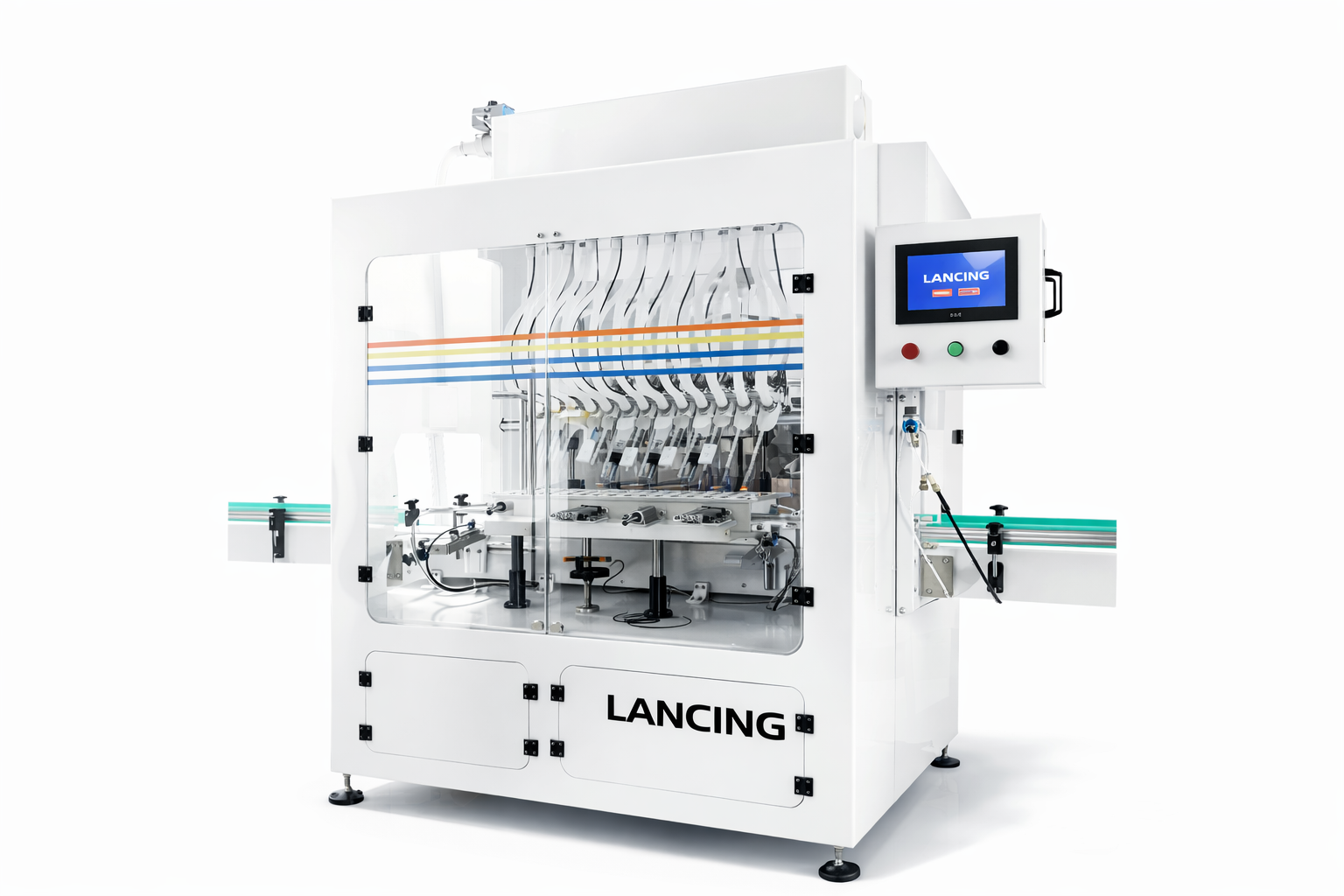
A corrosive filler cannot be selected by replacing one stainless component with plastic. Tanks, pumps, hoses, valves, seals, nozzles, sensors, drip trays and extraction interfaces must be considered as a complete product path.
The risk assessment also needs the chemical concentration, temperature, vapour, reaction with water, spill response and cleaning chemicals. The machine configuration and site services should be confirmed by competent engineering review before manufacture.
The final route should be confirmed against representative product and containers.
Uses chemically compatible tanks, pumps and product-path materials for free-flowing aggressive liquids.
May be selected where the product and compatible pump technology require a measured displacement route.
Nozzle movement and staged flow can reduce splash, foam and exposed droplets.
Guarding and local extraction interfaces may be needed after a site-specific hazard assessment.
The details differ by machine, but these stages define the core control problem.
Confirm concentration, hazards, incompatibilities and required engineering controls.
Match every contact component to the product and cleaning regime.
Indexing, nozzles, drip capture and fault response are designed together.
Commissioning confirms dose, controls, extraction interfaces and operator procedures.
A complete enquiry reduces avoidable assumptions and makes machine comparisons more meaningful.
| Chemical details | Full product name, concentration, SDS, temperature and vapour information |
|---|---|
| Wetted materials | Tank, pump, valve, seal, hose and nozzle compatibility |
| Machine enclosure | Guarding, corrosion resistance, ventilation and access |
| Spill control | Drip tray, drainage, bunding interface and leak detection |
| Electrical area | Hazardous-area classification where applicable |
| Cleaning | Flush medium, neutralisation, waste route and operator PPE |
Use these configurations to compare machine routes. Final fill range, speed and accuracy are confirmed against your product, container and line.
A corrosion-resistant PP machine configuration for strong acid, alkaline, oxidising and foaming liquids.
A filler performs best when infeed, closure, labelling and accumulation are sized around the same design rate.
Compare alternative filling methods and the equipment that may be needed before or after the filler.
Answers are general guidance. Final suitability depends on product trials, containers and the confirmed machine specification.
Provide the safety data sheet, concentration, temperature, fill range, container, closure, target output, site classification, extraction expectations and cleaning method.
Not necessarily. Material compatibility must be checked for every wetted component and for external parts exposed to vapour or spills.
No. ATEX requirements depend on the explosive-atmosphere risk, not on the general label ‘chemical’. A formal area and substance assessment is required.
Yes, but enclosure design, access, ventilation, extraction, corrosion resistance and emergency response must be engineered for the actual product and site.
Compare the next most relevant machine routes before you choose a final specification.
Send the product, pack and output details that matter. We’ll compare the most practical dosing and line options for you.